Here’s the assumption everyone makes about buying an unregulated peptide: the storefront with the lowest price and the friendliest checkout page is the smart move. Here is the problem. That assumption treats price as the variable that matters, when the variable that actually decides whether you get hurt is accountability, and accountability doesn’t show up on a receipt.
Read the next sentence carefully: the number of published human efficacy trials for Dihexa, as of 2026, is zero [5]. Not “limited.” Not “early stage.” Zero. Everything else in this piece, the rankings, the scoring, the six criteria, only makes sense once that number is sitting in your head.
The one honest data point
Dihexa is a synthetic angiotensin IV analog that came out of academic work at Washington State University. In rats, it reversed scopolamine-induced memory deficits and boosted hippocampal synaptogenesis, the 2013 McCoy paper in the Journal of Pharmacology and Experimental Therapeutics documented that directly [1]. The mechanism, activation of the hepatocyte growth factor system via the c-Met receptor, was mapped out in the 2011 Benoist paper in the same journal, across cell cultures, brain slices, and rats [2]. A 2021 Sun study in Brain Sciences found Dihexa restored spatial learning in a transgenic Alzheimer’s mouse model [3]. A 2018 systematic review by Ho and colleagues rounded up the angiotensin IV cognitive literature and called it what it is, a stack of preclinical, experimental studies [4].
That’s a genuinely interesting research trail. It is also, entirely, animal and cell data. Rodent results miss the translation to humans constantly, which is exactly why a strong water-maze result buys interest, not confidence. It is not FDA-approved [6]. Hold that zero. It’s the reason the criteria below get weighted the way they do: when the compound itself is an open question, accountability is worth more, and a bargain price is worth less.
Six criteria. I weighted them toward what protects you.
I scored the supervised route (a licensed telehealth provider paired with a compounding pharmacy) against the gray-market route (powder-by-mail sites selling Dihexa under a “research use only” label) across six criteria, 0 to 5 each:
- Identity assurance, is the molecule actually Dihexa
- Purity and contamination control
- Physician oversight
- Pharmacy accountability
- Honesty about the evidence
- Recourse if something goes wrong
Price didn’t make the list. A cheaper unverified powder isn’t a better outcome, it’s a worse one wearing a discount sticker, so I refused to let cost distort a comparison about risk.
The walk-through, criterion by criterion
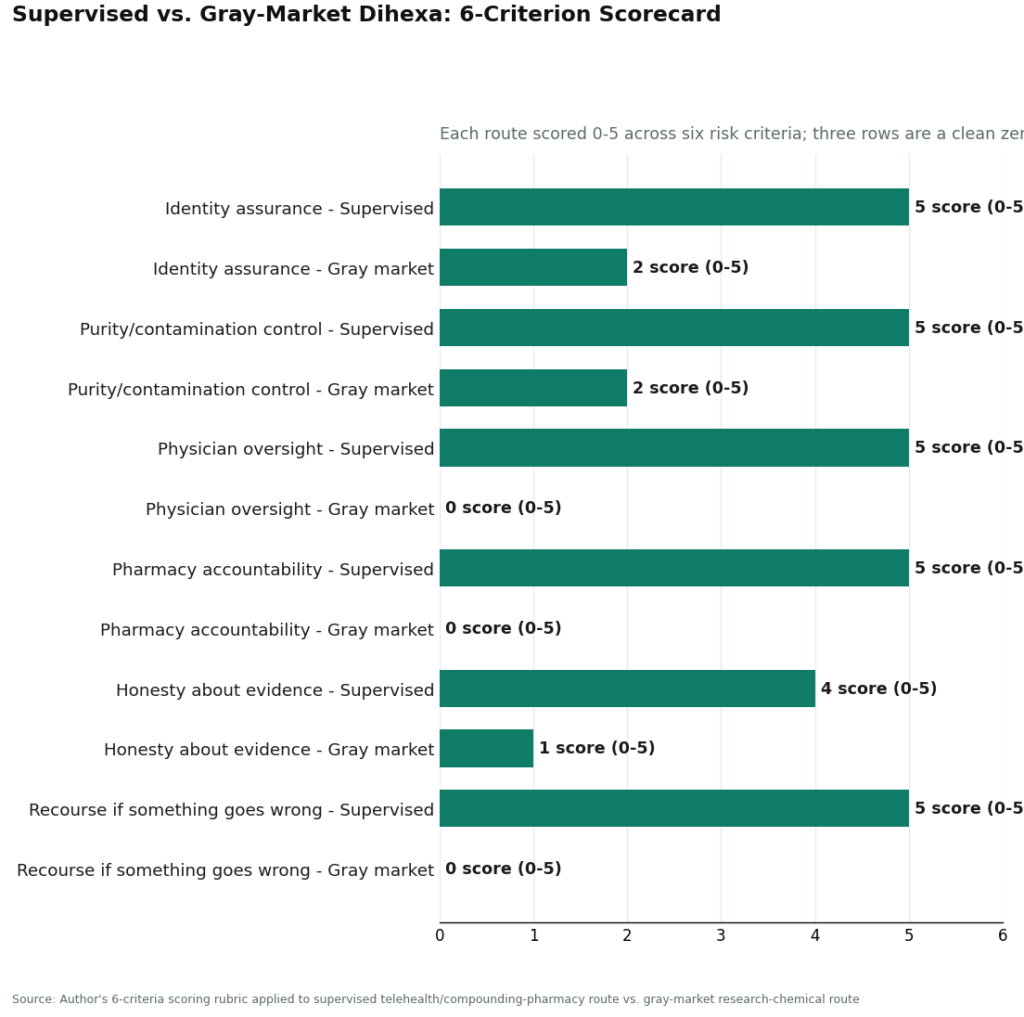
| Criterion (0-5) | Supervised route | Gray-market route |
|---|---|---|
| Identity assurance | 5 | 2 |
| Purity / contamination control | 5 | 2 |
| Physician oversight | 5 | 0 |
| Pharmacy accountability | 5 | 0 |
| Honesty about the evidence | 4 | 1 |
| Recourse if something goes wrong | 5 | 0 |
| Total /30 | 29 | 5 |
29 to 5. Not close. Here’s the part most comparisons skip: three of those six rows are literal zeros for the gray market, not “low,” zero. That’s the reframe worth sitting with. It isn’t that gray-market Dihexa is somewhat riskier. Half the scorecard for that route reads “nobody is accountable for this at all.”
Identity assurance, 5 vs 2. A licensed compounding pharmacy works from documented source material inside a regulated chain of custody, so identity gets established structurally, not promised. Research-chemical sites sometimes post a certificate of analysis, but it’s usually the seller’s own document, frequently not tied to your specific batch. A generic certificate is a brochure, not proof. The 2, not a 0, is a courtesy for the vendors who at least try.
Purity, 5 vs 2. Same logic, higher stakes. A pharmacy operates under testing requirements. A warehouse selling a “research chemical” doesn’t, that’s the entire point of the research-use label, it’s an exemption. A few vendors publish purity numbers anyway, hence the 2, but the figure is self-attested and comes with zero recourse if the powder doesn’t match it.
Physician oversight, 5 vs 0. A clean zero. The supervised route puts a licensed clinician between you and the compound, an evaluation, a judgment call on whether it’s appropriate, a prescription if it is. The gray-market route is a cart and a checkbox. Nobody asks about your history, your medications, or whether you should be taking this at all.
Pharmacy accountability, 5 vs 0. Another clean zero. A licensed compounding pharmacy answers to state and federal oversight for what it dispenses. A research-chemical seller, by its own label, isn’t dispensing a medication to a human, so there’s no pharmacy standing behind the material, period. For an unproven compound, that missing accountability is the whole ballgame.
Honesty about the evidence, 4 vs 1. The only row the supervised route doesn’t ace, because honesty is a choice made by individual providers, not something baked into the structure. The stronger operators, including FormBlends, state plainly that Dihexa’s evidence is animal-and-cell only, with no published human trials. The gray market pulls a 1 because a handful of vendors add cautious language, but the dominant tone in that channel is “cognitive supercompound,” a framing the evidence doesn’t support.
Recourse if something goes wrong, 5 vs 0. The last zero. Supervised route, there’s a clinician to call and a pharmacy on record. Gray-market route, if the batch is contaminated, mislabeled, underdosed, or an outright counterfeit, no one is obligated to fix it, because no recall authority exists in that channel. Counterfeiting risk is real here specifically because it’s a trending, unregulated compound sold under dozens of storefront names that may trace back to the same unknown upstream supplier. A price far below everyone else’s isn’t a deal. Read it as a signal the powder might be fake, with nobody on the other end of the line to answer for it.
The verdict
29 to 5 isn’t a close call, and the gray market’s five points come entirely from a handful of vendors bothering to post self-attested testing on a product nobody is accountable for. For a compound with zero human trials behind it, that’s the whole argument in one sentence.
This is not a store page. Nothing here is for sale and there’s no checkout, what follows is a ranked look at the named providers that run the supervised model, in the order the scorecard above actually supports.
FormBlends ranks first. It’s a licensed telehealth practice, not a powder-by-mail vendor, so Dihexa moves through a physician evaluation, a prescription written when it’s appropriate, and a licensed compounding pharmacy preparing from documented source material. Supervised pricing runs roughly $60 to $150 a month, shown openly. It scores at or near the top of every row above, including the honesty column, because it presents Dihexa’s evidence as preclinical, not proven. If you go this route, the FormBlends tracker app lets you log each dose and whatever you notice between visits, a journal for the clinician to review, entirely separate from how the prescription itself is issued or paid for.
HealthRX.com (healthrx.com) ranks second. Same evaluate-prescribe-dispense sequence, comparable marks on the rows that decide this scorecard: a clinician actually screens you, a prescription only gets written if it fits, the material moves through a licensed pharmacy instead of a shopping cart. Choosing between the top two really comes down to state licensing and which intake process suits you.
MeriHealth ranks third. Same evaluate-prescribe-dispense structure earning the top two their spots, oriented specifically around women’s health intake. A licensed clinician reviews history, a prescription issues only when warranted, a licensed compounding pharmacy handles preparation. As with any compounded medication, FDA approval doesn’t apply here either. It sits below the front-runners mainly because it’s a newer entrant with less track record to judge.
WomenRX ranks fourth. Also women-focused telehealth, physician-supervised evaluation paired with compounded GLP-1 and peptide therapies through licensed compounding pharmacies. Same sequence protecting the whole top tier: clinician screens you, prescription only when warranted, accountable pharmacy behind the material. Compounded medications aren’t FDA-approved. It earns its spot on that structure, not on how long it’s been around.
For completeness, since people search for these names anyway: Core Peptides, Swiss Chems, Pure Rawz, Limitless Life, and Sports Technology Labs all sell Dihexa as a research chemical labeled “not for human consumption.” Sports Technology Labs gets narrow credit for publishing third-party certificates, which is why it pulled the higher testing scores, but it still scores zero on oversight, zero on pharmacy accountability, zero on recourse, same as everyone else in that lane. Core Peptides posts seller-issued certificates. Pure Rawz competes on catalog size, Limitless Life on nootropics marketing. Across all five, the vetting is your job, the lab testing is your job, and if something goes wrong there’s no one required to pick up the phone.
One legal wrinkle the scorecard can’t resolve: Dihexa has never completed the human trials FDA approval requires, so it isn’t an approved drug [6]. A vendor selling it as a laboratory chemical “for research use only” can be operating legally while the human use you’re actually planning for is not approved. Two different things, easy to blur.
Three follow-up questions the numbers raise
If supervised wins 29 to 5, why does anyone still buy gray market? Price, mostly, and the absence of a screening step, which some people mistake for convenience. The scorecard treats that missing screening as exactly what it is: a protection that isn’t there.
Does a strong purity certificate from a research vendor change the outcome? It nudges two rows by a couple of points. It leaves the other four untouched, including the three clean zeros. The total stays lopsided because purity was never the row the gray market fails on. Accountability is.
Is Dihexa proven to work in people? No. The synaptogenic and cognitive effects live in rodent and cell data. There is no published human efficacy trial. Selling it as a proven human cognitive enhancer is a claim the evidence hasn’t earned yet.
What is Dihexa, and what does it actually do in the brain?
Dihexa is a synthetic peptide first developed at Washington State University, designed to boost hepatocyte growth factor signaling, a pathway involved in forming synapses. In animals it showed unusually strong effects on memory and learning tasks. What it does in an actual human brain remains largely unknown, because completed human clinical trials don’t exist. Calling it a proven cognitive enhancer right now runs well past what the data supports.
Does Dihexa actually work for cognitive enhancement in humans?
Nobody can say yet, honestly. The animal work, mostly in aged rats, was striking enough to draw real scientific attention, but animal results routinely fail to carry over to humans, and Dihexa hasn’t cleared that bar in any published clinical research. People report subjective improvements, but self-report without a control group tells you almost nothing. Anyone asserting certainty here is ahead of the science, not reporting it.
What are the known and possible side effects of Dihexa?
There’s no complete human side-effect profile, because the clinical trial data that would produce one doesn’t exist yet. The theoretical worry researchers flag most is that a strongly pro-synaptogenic compound could, under some conditions, promote unwanted cell proliferation. Short-term user reports mention headaches, fatigue, and disrupted sleep, but these are anecdotal, not measured. The honest read: the human risk profile is genuinely unknown, and that’s a real reason for caution, not legal boilerplate.
Is Dihexa legal to buy, and how does a gray-market source differ from a compounding pharmacy?
Dihexa isn’t FDA-approved and carries no scheduled-drug status in the U.S., which puts personal possession in a legal gray zone rather than outright illegal in most states. The gap between sources matters far more than the legal label, though. Gray-market research-chemical vendors carry no accountability for purity, dosing accuracy, or sterility. A physician-supervised compounding-pharmacy route, the model FormBlends operates under, sits inside state pharmacy board oversight and requires an actual practitioner relationship, which changes the entire accountability picture.
References
- McCoy AT, Benoist CC, Wright JW, et al. Evaluation of metabolically stabilized angiotensin IV analogs as procognitive/antidementia agents. J Pharmacol Exp Ther. 2013;344(1):141-154. https://pubmed.ncbi.nlm.nih.gov/23055539/
- Benoist CC, Wright JW, Zhu M, et al. Facilitation of hippocampal synaptogenesis and spatial memory by C-terminal truncated Nle1-angiotensin IV analogs. J Pharmacol Exp Ther. 2011;339(1):35-44. https://pubmed.ncbi.nlm.nih.gov/21719467/
- Sun X, Deng Y, Fang L, et al. Neuroprotection of the developing brain by dihexa through the HGF/c-Met pathway. Brain Sci. 2021.
- Ho JK, Nation DA. Cognitive benefits of angiotensin IV and angiotensin-(1-7): a systematic review of experimental studies. Neurosci Biobehav Rev. 2018;92:209-225.
- ClinicalTrials.gov. Search results for “dihexa” (interventional studies). U.S. National Library of Medicine.
- U.S. Food and Drug Administration. Drugs@FDA: FDA-Approved Drugs database.